

Thursday 13 May 2021
NEW PORTRAITS WEBSITE


Friday 14 September 2018
LAST DAY IN GASCONY
Suzanne’s fall painting trip to France is coming to an end.
But there’s one day left, so let’s get on with it.
Breakfast. Painting. Picnic. Painting. Back to La Petite Galerie. Painting. Crit. Dinner. Bed.
Quite a full day, as you can see.
Here are some visual memories.
So that’s it folks for 2018.
Tomorrow it’s au revoir et bon voyage.
Back to the USA.
Hope to see y’all again sometime.
Amicalement et bisous,
Ray & Lynne
But there’s one day left, so let’s get on with it.
Breakfast. Painting. Picnic. Painting. Back to La Petite Galerie. Painting. Crit. Dinner. Bed.
Quite a full day, as you can see.
Here are some visual memories.
 |
| Painting in the medieval bastide of Larressingle. |
 |
| Amongst the roses at Fources . |
 |
| Picnic at Larressingle. |
 |
| Under the trees, deep in thought about colour, composition and technique. |
 |
| Last dinner in Gascony at La Table des Cordeliers in Condom. |
So that’s it folks for 2018.
Tomorrow it’s au revoir et bon voyage.
Back to the USA.
Hope to see y’all again sometime.
Amicalement et bisous,
Ray & Lynne
Monday 10 September 2018
SUZANNE’S PAINTING HOLIDAY IN FRANCE—FALL 2018
They’ve come to paint, and while they’re here we hope to have a bit of fun along the way.
Wine is important so we’ll do some wine and Armagnac tasting.
Food is important so we’ll test quite a few local restaurants to see how they rate.
Markets are important so we’ll visit a few of those too.
And there are some wonderful, very old and beautiful villages to see as well.
Everyone loves Lynne’s picnics so they’re also on the agenda.
Oh yes, and then there’s the art component. So we’d better get on with painting a few pictures as well.
The cliche is that pictures are worth a thousand words, so here we go with some photos of what we get up to.
 |
| Theresa, Jan and Suzanne painting amongst the vines at Lectoure. |
 |
| Leigh Anne, Elaine and Ray working it all out. |
 |
| That’s Debbie in the background |
 |
| Picnics are always popular. This one’s on the banks of the river in Nerac. |
 |
| Painting outside a medieval house in Nerac. |
 |
| Preparing to paint a portrait at La Petite Galerie. |
 |
| Lunch at the Contes d’Albret. This restaurant specialises in duck. |
 |
| All in a day’s work. |
 |
| Jan and Andy. |
 |
| Debbie and Donald. |
 |
| Rebecca and Marilyn. |
 |
| Suzanne and Rudolph. |
 |
| Leigh Ann and Jackie. |
 |
| Theresa and Jane. |
 |
| Elaine and Audrey. |
 |
| Picnic lunch at the Chateau du Frechou. |
 |
| Preparing to paint the pigeonnier at Le Frechou. |
 |
| Theresa’s version. |
 |
| Leigh Ann with hers. |
 |
| Elaine with her version. |
 |
| Suzanne with hers. |
 |
| Watch out! Big Brother’s always watching you. |
 |
| Finishing off the paintings. |
 |
| Debbie decided to paint the Orangerie as well. |
 |
| Now it’s 6.45 PM and they’re at it in the garden at La Petite Galerie. |
So that’s what we’ve done so far, but tomorrow we visit Condom (where the Three Musketeers and d’Artagnan came from. Then we go on to the tiny bastide of Larressingle. And we’ll be painting in Fources after lunch. So come back for more when you have the chance.
Saturday 23 June 2018
ALL THE WAY FROM AUSTRALIA
Max and Elvyne came to stay—all the way from Australia.
While they were here they found time to …
…hobnob it with the local Maire. The pic shows them on the Mairie (Town Hall) steps with President Macron’s man in Mezin.
We also travelled around Gascony showing them all the nearby attractions—Condom (yes that’s really it’s name), Lectoure, Montreal, Nerac and several others.
And Max even found time to paint a watercolour at the round bastide of Fources.
Then we put them on the plane at Bergerac on their way to Blighty and Ireland.
Bon voyage! Hope to see you again one day.
While they were here they found time to …
 |
| Slumming it with a local politician |
…hobnob it with the local Maire. The pic shows them on the Mairie (Town Hall) steps with President Macron’s man in Mezin.
We also travelled around Gascony showing them all the nearby attractions—Condom (yes that’s really it’s name), Lectoure, Montreal, Nerac and several others.
And Max even found time to paint a watercolour at the round bastide of Fources.
 |
| Look what I painted today! |
Then we put them on the plane at Bergerac on their way to Blighty and Ireland.
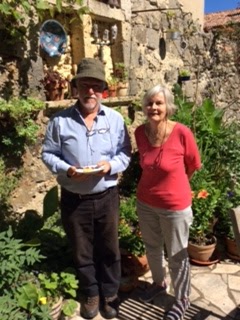 |
| A quick bite in the garden, and then it’s time to say goodbye |
Bon voyage! Hope to see you again one day.
Friday 25 May 2018
BUON CAMINO!
Gai Jacobs is back in our neck of the woods. Walking on the St Jacques route to Compostela. This time with her friend Bev (who has walked the route several times).
Gai and Bev in the garden at La Petite Galerie.
We first met Gai when she came to Gascony exactly three years ago, almost to the day, in May 2015. She was with a group friends who were on a “Learn French on Holiday in France” at La Petite Galerie.
 |
| Gai and Bev at lunch in the garden at La Petite Galerie (2018) |
 |
Alistair, Helen, Annette, Gai, Dawn, Lynne and Philip outside
"The Bastard" in Lectoure in 2015. |
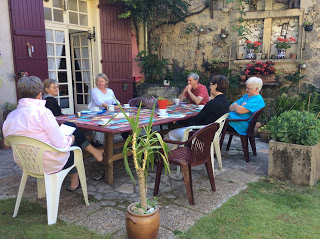 |
| Gai and friends have a French lesson en plein air at La Petite Galerie in 2015 |
 |
| A painting lesson was also on the menu three years ago |
While they were here we walked from Condom to Larressingle on the GR 65. The walk seems to have given her the taste “to do The Big One”—their current walk has taken them from Le Puy to Mezin—and they’re now on their way to the Pyrenees, Pamplona, and Compostela in far western Spain.
BON CHEMIN et BON COURAGE!
Monday 30 April 2018
THREE WEEKS IN BAHRAIN

Heat and sand. Beautiful.
Three weeks in the Middle East often took my memories back to the Red Centre in Australia.
So I painted this picture for Mat, Vicky, Jack and Tom.
Tuesday 10 April 2018
RAY & FRIENDS (LIFE SIZE AMAM & EVE - UPDATE)
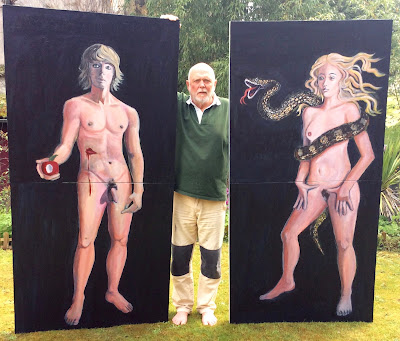
This is what my latest diptych looks like on 10 April 2018.
Hope you like it.
Earlier versions at various stages of development can be seen at other posts on this blog.
Watch this space if you’d like to see how it develops.
And please contact me if you have any questions or comments.
Hope you like it.
Earlier versions at various stages of development can be seen at other posts on this blog.
Watch this space if you’d like to see how it develops.
And please contact me if you have any questions or comments.

Subscribe to:
Posts (Atom)